The British Tradition of Conkers: History, Rules and Community Guide
The british tradition of conkers is one of the few autumn customs that still pulls three generations onto the same patch of grass. Every October the british tradition of conkers reappears in school playgrounds, parish halls and pub car parks, wherever a horse chestnut has dropped enough ammunition to fill a carrier bag. The game is brutally simple: a seed drilled through the middle, threaded onto a 25cm bootlace, and swung at an opponent’s nut until one of them shatters. Behind that simplicity sits a deep body of technique, etiquette and competitive structure, including the World Conker Championships staged in Northamptonshire since 1965, an event that has raised six-figure sums for charities supporting blind and partially sighted people. This guide covers the origins, the preparation methods that genuinely work, the scoring used at organised events, and the real cost of running a tournament for your own village.
Where the British Tradition of Conkers Began
The horse chestnut, Aesculus hippocastanum, is not native to these islands. It arrived from the Balkans in the early seventeenth century as an ornamental planting for large estates, which means the tree spent roughly two hundred years dropping seeds in Britain before anyone thought to drill a hole through one and start a fight with it.
The first written record of the game appears in 1848, describing children on the Isle of Wight. Earlier versions used hazelnuts and snail shells, played under regional names such as conquerors and cobblers. The switch to horse chestnuts happened because the seeds were larger, free, and available by the thousand in every churchyard and avenue planting.
Victorian schools spread the game nationally. By the 1880s it was standard playground currency across England, Wales and lowland Scotland, with a scoring system built on inherited victories. The rhythm was seasonal and reliable: late September collection, October competition, November decline as the last nuts dried out and cracked in coat pockets.
From Snail Shells to Horse Chestnuts
The older shell-based games left a lasting mark on vocabulary. The word conker most likely derives from conquer, though some etymologists trace it to the French conque, meaning shell. Both explanations point at the same origin: a contest between two hard objects where the survivor inherits the loser’s record.
Regional dialect preserved the transition. In parts of Yorkshire the game was called cheggies, in the Midlands oblionkers, each with its own chant shouted before a strike. Village history societies collecting oral testimony still find people in their eighties who use these terms without hesitation, which makes them a useful hook for local heritage projects.
Choosing and Preparing a Match-Winning Conker
Selection matters more than preparation. A champion conker is dense rather than large, symmetrical rather than dramatic, and free of hairline cracks around the pale scar where it sat inside the case. Drop candidates into a bowl of water: floaters are hollow or drying out, sinkers have retained the internal density that resists impact.
Drilling is where most nuts are lost. Use a 3mm bit in a hand drill or a bradawl, work from the flat base towards the crown, and go slowly enough that the bit does not snatch and split the shell. Thread with a boot lace or leather thong rather than string, then knot generously.
Before committing to a tournament nut, run a simple checklist against every candidate you have collected:
- Sinks in water within three seconds, with no bubbles escaping
- Circular cross-section, so it presents the same face at any rotation
- Shell colour deep mahogany, not pale or blotchy
- No soft spot when pressed firmly with a thumbnail
- Weight between 12g and 20g, checked on kitchen scales
Hardening Methods and What Referees Actually Ban
Folk hardening methods are numerous and mostly counterproductive. Soaking in vinegar for thirty minutes and baking at 120C for ninety seconds does harden the outer shell, but it also drives out moisture and makes the interior brittle, so the nut survives two rounds then disintegrates spectacularly on the third.
The method that genuinely works is patience. Store a conker in a dark, dry drawer for twelve months, then bring it out the following autumn. Organised competitions counter this by supplying all nuts from a common pool, which removes any advantage from preparation and keeps matches decided by aim and nerve.
The Rules, Scoring and Etiquette of a Proper Match
Formal play works on alternating strikes. One player holds their conker still at arm’s length, the other takes up to three attempts to hit it, then the roles reverse. A miss counts as a turn used. The match ends when one conker is destroyed, defined as no longer attached in a strikeable piece.
Scoring is inherited. A fresh conker is a none-er. Beat a none-er and it becomes a one-er; beat a six-er and you take its six victories plus the one you just earned, becoming an eight-er. This compounding rule is what turned playground games into season-long campaigns with reputations attached to individual nuts.
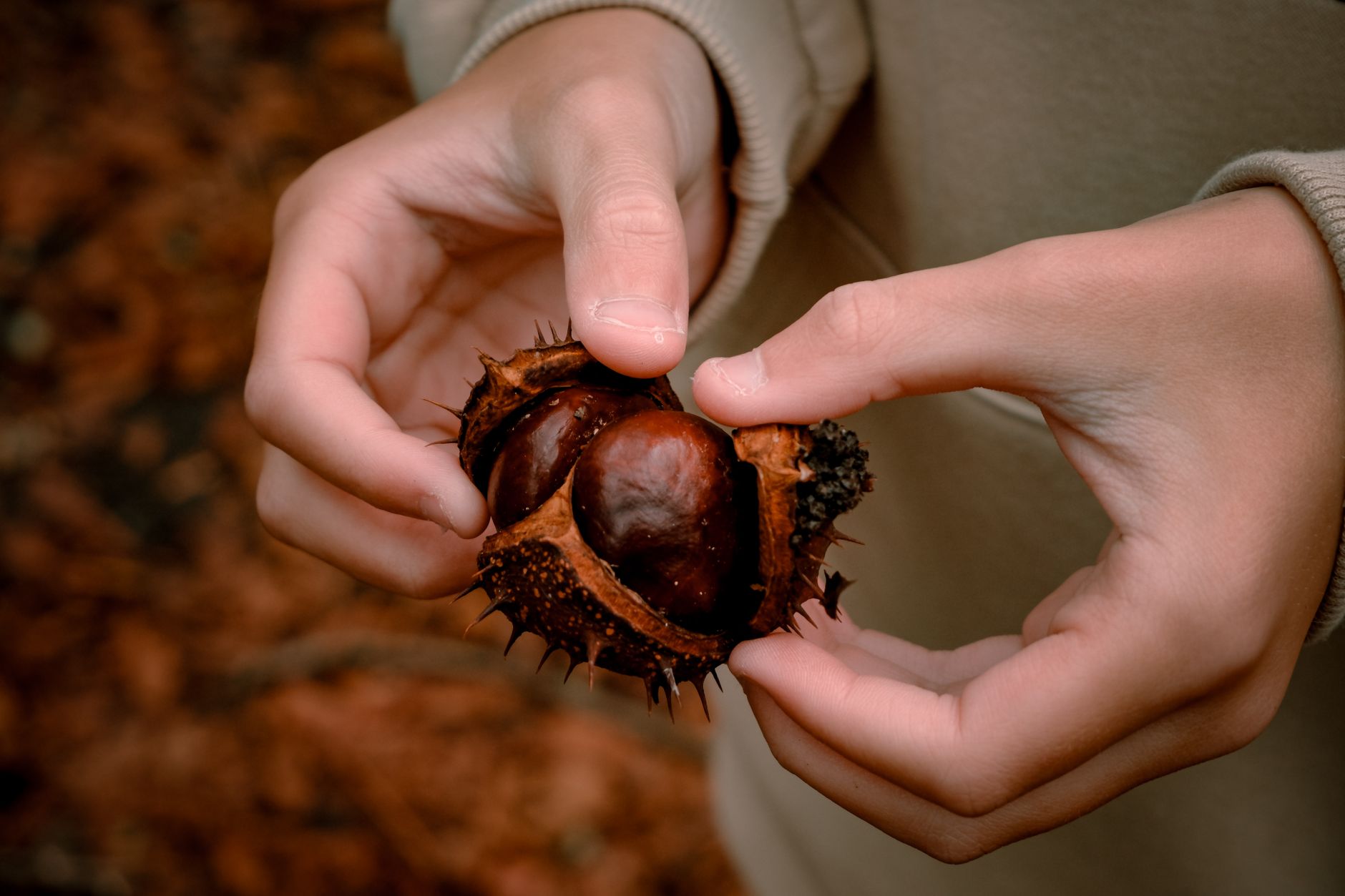
Etiquette covers the rest. Snags, where laces tangle, are called by shouting strings, and the first to call takes an extra shot. Stamping on a dropped conker is permitted unless the owner shouts no stamps first. Deliberate hand strikes and lace grabbing are penalised at every organised event.
Running a Community Conker Tournament
A parish tournament is one of the cheapest fundraising formats available. A knockout draw of 32 entrants takes about ninety minutes including a break, needs two officials and one scorer, and fits comfortably alongside a produce stall or bar. Entry fees of £3 to £5 per adult and £1 per child are typical.
Safety provision is the one area committees underestimate. Eye protection is now expected at any event open to the public, and a shattering conker throws fragments at speed. Budget for goggles, mark a clear exclusion zone of two metres around each pair, and brief spectators before the first round rather than after an incident.
The table below shows a realistic starting budget for a village green event with 32 competitors and an audience of roughly one hundred.
| Item | Typical cost | Notes |
|---|---|---|
| Bootlaces, pack of 100 | £8 | Leather or waxed cotton, 30cm |
| Drill bits and bradawl | £12 | 3mm bits, buy spares |
| Safety goggles, 10 pairs | £45 | Reusable across future years |
| Public liability cover | £60 to £120 | Often included in hall insurance |
| Trophies and rosettes | £35 | Engraved shield plus junior prizes |
Conkers, Noticeboards and the Autumn Community Economy
The same parish noticeboard that carries your tournament poster carries everything else the village is trading. Committees consistently report that the busiest cards are the animal adverts, and a handwritten french bulldog puppy for sale notice or a puppy french bulldog for sale card pinned beside the raffle sheet will hold attention far longer than a fixture list ever does.
Search behaviour on community websites follows the same seasonal curve. Autumn traffic spikes for conker queries, and alongside them sit phrases such as puppy for sale french bulldog, french bulldog puppy for sale uk and puppy french bulldog for sale uk, because half-term coincides with the point at which families finally commit to a new dog after a summer of discussion.
Proximity language dominates the rest. Local directory logs fill with english bulldog puppy for sale near me, puppy bulldog for sale near me and british bulldog puppy for sale near me, which tells parish web editors something useful: residents want a five-mile radius, not a national listing site, and they apply the same instinct to events, tradespeople and clubs.
Price expectations vary widely across those categories. A blue french bulldog puppy for sale commands a premium over standard colours, and the broader french bulldog puppy price uk range sits between roughly £1,500 and £3,500 depending on health testing and pedigree. Adverts for a mini bulldog puppy for sale or an american bulldog puppy for sale near me typically sit lower, which is worth understanding before your committee sets advertising rates for the noticeboard.
How do you harden a conker without breaking the rules?
The only method accepted at every organised event is natural ageing. Collect a dense, water-sinking nut, drill it cleanly, then store it somewhere dark and dry with stable humidity for twelve months before it sees competition. The shell hardens gradually while the interior contracts evenly, which is exactly the combination that survives repeated impact. Vinegar soaking, oven baking and clear nail varnish all produce a hard outer layer over a brittle core, and most referees will reject a nut that smells of vinegar or shows an unnatural gloss. If your event supplies conkers from a shared bucket, as the World Championships do, none of this matters and the match comes down purely to technique.
Is the british tradition of conkers still allowed in UK schools?
Yes, and it always has been. The widely repeated story that health and safety legislation banned the game or required goggles is a misreading of one head teacher’s decision in 2004, which the Health and Safety Executive itself has publicly described as an unnecessary overreaction. There is no national prohibition and no regulation naming the game. Individual schools set their own playground policies, so some restrict play to supervised sessions or a designated area, and a small number ask for eye protection during organised matches. If your school has stopped, the practical route back is a short risk assessment covering supervision, a marked playing zone and a rule against hand strikes.
What size of conker actually wins the most matches?
Medium and dense beats large and showy in almost every competitive analysis. A nut weighing between 12g and 20g with a near-perfect circular cross-section delivers the best combination of striking mass and structural integrity, because the load spreads evenly through the shell instead of concentrating on a flat face. Very large conkers look intimidating but frequently contain internal voids from rapid growth, and they present an uneven profile that catches badly on impact. Very small ones lack the momentum to break anything. Test candidates in water, weigh the sinkers on kitchen scales, and keep the three that sit closest to a sphere.